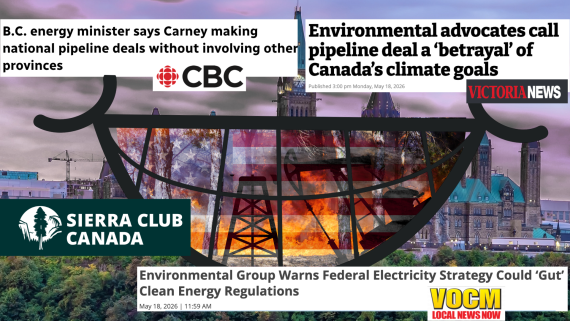
When one plant is allowed, others may follow, possibly opening the door to fracking and gas pipelines.
It is true that in a global sense renewables are out-competing gas and nuclear at an accelerated pace, but Canada is in a different situation. Despite being only a small part of our economy oil and gas interests hold a massive amount of influence at various levels of government. Oil and gas corporations are not 'innocent market actors' who only respond to demand, they actively seek to control local decision making process to maximize the use of their products.
We've seen this already in Alberta were damage was done to renewable energy growth through various measures that counter-act the market advantage of renewables.
Oil and gas corporations are more than aware that global demand for their product is going to decline soon. Their response will be to try to maximize domestic reliance on gas as much as possible - and now they have a room to do that. The Guardian has pretty good article on this here and we warned about it repeatedly in our Sovereignty Saturday's Podcast.
Strong national climate policies were an obstacle to them, helping to guide our energy course in favour of renewables. With those gone it will matter more than ever that you promote renewables locally and oppose new gas plants.
Canada is gutting the clean electricity regulations to enable more gas plants to be built - likely to power AI-slop-machines (again there's a difference between those and a sovereign cloud). AI companies are great at finding sneaky ways to gain access to power and water needed by communities instead and the Federal Government has dangerously naive approach to AI. Fortune reports that: "Nearly 50,000 Lake Tahoe residents have to find a new power source after their energy source looks to redirect lines to data centers." Right now, in Canada, AI projects like Kevin of O'Leary's are being exempted from impact assessments provincially and making inroads federally.
If you want to build more gas plants then you're clearly not interested in protecting the environment. Battery storage solutions mean we do not need gas plants for base load power anymore. More on that in a podcast here.
The few provisions for renewable energy secured recently are vague and thus easy to undermine by oil and gas interests. They rest on the idealistic notion that oil and gas interests will play nice - interests who specialize in finding ways to undermine vague policies (see the 'cannon analogy' below). The enforcement of those provisions for renewables would again require the Federal Government to actually levy consequences if they are broken. Given how much the Federal Government has already caved on the previous commitments to an emissions cap and a strong industrial carbon price, consequences are unlikely to happen.
All that's not to mention that beyond 'the market' we're already subsidizing oil and gas corporations heavily and might be about to help them out even more.
2) No, gutting climate policies to this extent was not necessary for national unity.
We've noted before that polling shows strong support for climate action and policies aimed at big polluters across the country - including in Alberta and NL. These cuts were extreme and far beyond what could be justified by 'national unity.' Again, what's worse they actually embolden those who want chaos by showing them they can get ever more concessions if they just keep being louder and louder. This is - actually - the oldest trick in the book when it comes to eroding democracies: getting governments to increasingly compromise on values is a tactic that dates back to the early 20th century (see Part 2, 45 minutes into this podcast).
Let's not forget people are being sold on pipelines and LNG projects that have no business case here. What happens when those people find they've been lied to? Fallout will happen, and it could happen sooner rather than later now.
It's a good time to remember the fable of the boy who cried wolf.
Let's look at the larger picture here too because a lot of other environmental protections are being eroded by the Federal Government that have nothing to do with national unity.
No, these are not just minor de-regulations that are happening. You aren't a utopian idealist for taking the threat of 'lawless zones,' where corporations can do what they want, seriously. As is illustrated by plans to massively de-regulate pesticides - a move even a lot of climate deniars I've encountered would oppose - the health and wellbeing of Canadians is on the line.
The 4D chess argument is meant to fool us into focusing on a pipeline and a few policies alone, not the wider picture. That trick is the one actual move the Federal Government has played.
Whether the Federal Government either failed to negotiate a stronger carbon price - or simply didn't intend to - it says a lot about willingness to stand up for Canadians. How much appeasement will we see the U.S. Government and U.S. corporations get in general because of a similarly weak appraoch? So far we're at the point of shipping them gas for their AI-slop-machines, and increasing our defence spending as an act of appeasement did not work.
3) No, the deal did not strengthen industrial carbon pricing, it has been weakened. And no, we cannot reach Net-Zero by 2050 under these conditions.
As the Energy Mix covered recently:
"Canada’s Clean50 founder and executive director Gavin Pitchford said federal climate rollbacks are already undercutting the development of Canada’s clean economy. '$130 per tonne by 2040 will decimate an industry that all in, across the entirety of the clean economy, is over $200 billion in GDP.'"
The actual gutting of the Industrial Carbon Price is arguably worse than that as the IISD notes:
"Details of the Canada-Alberta implementation plan allow for a minimum carbon price of just CAD 110 in 2040—far below the CAD 130 advertised, and far too late to meet climate commitments."
There are also concerns about the double-counting-of-credits as a result of the specifics - you can read more about the impact of double-counting here.
Saying the Federal Government strengthened the industrial carbon tax, because they didn't officially remove it, is deeply flawed: that wasn't the assignment, the assignment was an ambitious industrial carbon tax to make up for the scrapping of the emissions cap and other climate policies. This is NOT that.
Imagine inviting someone in to your house, having them smash all your plates and cups, but then they say it's okay because they'll buy you new ones. A week later they arrive carrying one single teacup. They then proceed tell you you have to be 'pragmatic about the situation' and tell you that you should thank them for having at least bought a teacup. That's what's happened here.
As the Canadian Climate Institute confirms there is no chance of reaching Net-Zero by 2050 as a result of these policy changes:
"The MOU agreement’s unreasonable compromises on industrial carbon markets and clean electricity regulations, and the implications for weakening policies in other provinces, will undermine emissions reductions and Canada’s low-carbon competitiveness....
'While the MOU agreement promises to make improvements to how the carbon market functions, the announced design changes will not be strong enough to fix market fundamentals and reach the intended effective market credit price by 2040. That undermines the credibility of the deal.... Further, the federal government’s plan to put the Clean Electricity Regulations in abeyance without any credible path forward increases policy uncertainty in Alberta and opens the door for more provinces to seek special treatment. That risks locking in more long-lived, high-emissions gas-fired power, exposing ratepayers to more volatile energy costs, and further stifling growth in Alberta’s previously thriving renewable energy sector.'"
4) No we did not need to be more realistic about climate targets - that's not pragmatism, it's an excuse.
One thing we do know is that big polluters love to try to find ways around emissions policies, that's what happened previously on methane, and will continue to happen going forward though various means like the double-counting-of-credits.
Industrial carbon pricing can be an effective policy, but it can also be the a great policy to hide behind while not actually achieving intended targets because it is inherently more complex to understand. That's why you need other policies around it to make it effective - policies like an emissions cap and clean electricity regulations.
It's also why you aim high when attempting to reduce emissions. There will be failures, loopholes will be found by corporations, but you'll achieve more for having aimed higher than what you'll get if your targets are weak. Aiming at what's 'practical' on emissions reduction, rather than at a point above it, is a bit like aiming a cannon without accounting for gravity and wind resistance and then yelling 'look at how pragmatic I am.'
5) No, Carbon Capture and Storage is not an emissions solution - not in Norway, nor in Canada: It is also dangerous and helps funnel more public money toward oil and gas corporations.
As Edward Donnelly wrote last year:
"Equinor has retracted a claim that it stores about a million tonnes of carbon dioxide annually at its flagship carbon capture project after DeSmog obtained data showing the real figure was as little as a tenth of that amount."
That's not an isolated incident, carbon capture and storage (CCS) does not work, doesn't account for downstream emissions, is effectively a way to further subsidize U.S.-owned oil and gas corporations. Far from just being a false solution it also comes with a huge risk to local communities. As Aly Hyder Ali writes:
"CCS is incredibly costly and inefficient – it requires billions of dollars in subsidies for minimal emissions reductions.... most projects don’t ever make it off the ground, and the small percentage that do underperform vastly.
Behind the greenwashing from the oil and gas industry lies a growing body of concern about the real-world dangers of CCS infrastructure. Transporting the captured carbon requires a network of high-pressure pipelines, which can and have exploded in the past. In 2020, a pipeline rupture in Mississippi sent 45 people to the hospital and required hundreds of people to be evacuated.
There are also risks to groundwater aquifers, which could be contaminated if leakage occurs. In Canada, these risks disproportionately impact Indigenous communities.... Furthermore, most of the (small amount) of captured carbon is ultimately used for digging up more oil and gas."
6) No, a pipeline does not have a market, but yes the Federal Government is serious about it anyway, and yes they are looking at ways to finance it publicly (at least in part).
For oil and gas corporations, none of this really is about a pipeline to the west coast. This has from the beginning been about removing climate policies. But that does not mean the Federal Government isn't making an honest attempt to build a new pipeline and it does not rule out the possibility they might go back on their word - again - and try to publicly fund one.
Already the federal Energy Minister has said that a pipeline could receive federal financing via the Indigenous loan guarantee program. That's potentially disastrous for all involved. Then there's the very suspicious not-a-sovereign-wealth fund they set up recently, which could very well amount to yet another taxpayer money funnel to de-risk oil and gas projects. Along with the selling off of public assets to de-risk oil and projects in a UK-style privatization push, that is.
If a consortium of companies does come forward to build a west coast oil pipeline with the Federal Government backing it - i.e. using taxpayer dollars to transfer the risk off of those corporations - then it WILL be the public that pays the price in the end. Remember all the claims that a private interest would buy the Trans Mountain pipeline? Well now the “Trans Mountain Corporation and its financial overseer are making a pitch to keep the controversial, $34-billion pipeline in government hands indefinitely” as The Energy Mix reports. Apparently no private interests see the value in it. That news also comes after the Tyee reported that ‘Trans Mountain’s Profitability could be an Accounting Illusion.’
You can take action:
Other fact sheets of use: Wind Power, Electric Vehicles, Canada Can Go Renewable, why batteries make new gas plants and nuclear power obsolete. |